Tuesday, 26 May 2015

If Sex Video-games Make You Feel Weird, That’s the Point ;-)

NINA FREEMAN DOESN’T quite know why so many of her games have been about sex. “It just kinda happened,” she says. “Sex is something I think about all the time, so I guess that’s why it comes out of almost everything I do.”
Freeman, an independent game designer, has recently found herself at the forefront of a wave of new games that grapple with sex in novel ways. Her “vignette games” aren’t interactive porn; they’re quirky game designs that explore snapshots of her life, often tapping into formative experiences she had with sexuality and femininity.
Games that deal with sex in a realistic way are largely unexplored territory. Mainstream games with sex scenes like Mass Effect or God of War exist to titillate and empower. But indie designers like Freeman are pushing back, hoping to recouple sexuality and humanity by making players feel confused, awkward and vulnerable. (The games are usually available on PCs, sometimes for free, sometimes right in a web browser.) Games like Robert Yang’s Hurt Me Plentyand Christine Love’s Ladykiller in a Bind take similar approaches.
“There’s nothing sexier than letting down your guard and seeing someone else let down their guard too,” says game designer Yang.
Click to Open Overlay Gallery

How Do You Do It?


When she was a young girl, sex confused Nina Freeman. With little more than a handful of playground rumors (and the quick flashes of nudity inTitanic) to go on, she wasn’t sure how two people could even fit together. So sometimes while her mother was out of the house, she’d try mashing her Barbie and Ken dolls together. Her game How Do You Do It? replicates those furtive experiments.
“It’s a young white girl playing with Barbies,” Freeman says. “So it’s pretty safe as far as sex goes. There’s nothing graphic to it.” Her game is simple; you play it with six keys. With them, you can maneuver the dolls into positions that vaguely imitate the physicality of sex.
How Do You Do It? is an extremely short game; a session takes a few minutes at most. But in its sonnet-like brevity, it elegantly captures a quintessential bewilderment people have with their bodies, and the naturalness of sex using a veneer of comedic awkwardness. It’s the Goat Simulator of intercourse.
The abstraction helped in its popularity, according to Freeman. “Some people thought the game was perverse,” she said, “but most saw it for what it was: funny.”
Freeman’s latest game, Freshman Year, is more somber, and it hasn’t yet attracted the attention that her previous work did (it was shown at festivals like Indiecade and the Independent Games Festival, for example). How Do You Do It? was approachable in its haphazard fumblings, but Freshman Year is cutting, almost precise, in its attempt to distill the frightening experience of sexual assault.
Screen Shot 2015-05-21 at 10.20.01 AMClick to Open Overlay Gallery
The game follows Freeman during one evening during her first year of college, when she was assaulted outside a bar. As text sprawls across vivid watercolor backgrounds, players can choose what to do. The choices, Freeman says, are meant to tap into a feeling faced by many survivors of abuse: that maybe if they’d done this or that differently, they could have avoided the whole thing.
Towards the end, Freshman Year‘s text changes from large blocks packed with florid descriptions to short, aggressive cuts. It creates a sense of unease, because you can’t sit and process the language at your own pace. You’re guided, somewhat forcefully, by events.
“People aren’t used to losing agency in such a violent way, and I made it violent because that’s what it is,” Freeman says. It’s an inversion of what we expect from video-games: Usually, it’s us inflicting violence on the game world. Freeman tries to flip that script, briefly taking us through her own memories. We can analyze them a bit, but before long, that control is taken from us, just as it was taken from her that night.

Submissive, Not Passive:


“Every power exchange must be negotiated,” read the posters that line the walls of an electronica-fueled sex club in Robert Yang’s game Hurt Me Plenty, a simulation of real-life dominant-submissive relationships that teaches players about BDSM culture.
The game begins with a classic negotiation—a handshake. (You can use a Leap Motion controller to make that experience even closer to the real thing.) You shake your hand to agree upon the intensity, clothing level, and safeword for the game’s activities, or stop shaking if you disagree and want to re-negotiate the terms.
As the player, you could violate those terms. If your computer partner uses the safe word, you’re expected to stop everything immediately. If you don’t, the game blocks you out and displays a message: “Your partner is still recovering from the previous player’s abuse and violation of boundaries.” The game then locks you out of play for some amount of real-world time—typically measured in days.
It’s stark and dramatic, but effective at communicating the importance of acknowledging and respecting the trust a partner places in you: you have power and violence, but with the expectation that you’ll only use them within well-defined limits.
Hurt Me Plenty.Click to Open Overlay Gallery
The game Ladykiller in a Bind explores some of the same themes, but through the eyes of both a dominant and a submissive. It’s a work in progress from Christine Love, a game designer whose work is modeled on and sometimes parodies the Japanese “visual novel” genre of occasionally pornographic romance games.
Love says she plays a lot of games that deal with kinky sex, but finds that the vast majority of them put the player in a dominant role. In part, she says, it’s a game design problem. “It’s a lot easier to depict taking the lead in any given scenario, but again, sex is communication, and being submissive isn’t the same as being passive.”
By placing her audience in several distinct scenarios, Love hopes that she can underscore her view of sex as a communicative act, a metaphorical handshake.
Playing games like Yang’s and Love’s can feel silly, if not downright uncomfortable. That’s all by design. In an email to WIRED, Yang likened his work to romantic comedies, calling them “emotional fantasies” that can be embarrassing. Admitting that you like them is an act of vulnerability, and that places us in a position where we have to admit something personal to ourselves.

“So many games lack basic emotional intelligence that what I’m doing is really radical and shocking by comparison,” said Yang. In mainstream games where sex is an option, it’s usually boiled down to clicking “sex” and watching a scene fade to black.
“These games simply aren’t about sex,” Yang says. “We pretend they are relevant to this discussion about sex games when they aren’t. Can we finally stop giving a shit about 10 seconds of blue boobs in Mass Effect?”
More than anything, Yang says he wants to see games tackle sex as it actually happens in real life.
“Sex takes time,” he says. “Even a quickie in the morning before work takes at least five minutes. Very few mainstream games would have the courage or the patience to let you flirt with someone, much less have sex with them for five whole minutes.”

Netflix Wants to Usher in a New Golden Age of Nonfiction TV

FRANCIS MALLMANN LIVES off the grid. Way off the grid. To find him, you’d have to fly to Argentina, drive 100 miles down a dirt road, and enter the Lago La Plata. You’d cross your fingers, row across the lake, and hope to stumble onto his island. If you found him, he’d be drinking red wine, watching an open fire, and grilling the best lamb you’ve ever eaten.
“My big draw in life,” Mallmann might tell you, “since I was very young was freedom. The freedom of believing only in myself and not letting myself be led by anybody. I wanted to be my own. I wanted to do whatever I wanted.” He lives in Patagonia, cooks over an open flame in the snow, and encourages dinner guests to eat outside under a blanket. Mallmann is a badass—and he’s one of the most renowned chefs in the world.
He’s also one of six incredible chefs featured in Netflix’s first original non-fiction series, Chef’s Table, that launched at the end of April. You might not be able to fly to Argentina, but you can certainly hear his story on the show. Each episode centers on one chef’s life, style, and artistic inspiration. There’s no host, very little shouting, and a lot of artful close-ups of exquisitely designed meals. It’s unlike any cooking or food show you’ve seen on network TV.
That’s because it comes from Netflix.
"The company aspires to become a paradise for filmmakers by offering big budgets, artistic freedom, and access to a massive audience of subscribers."

As Netflix expands rapidly beyond the US and increasingly develops its own original films and shows, nonfiction is its newest ambition—and it wants to be different. Traditionally, documentaries have targeted niche audiences, defiantly unconcerned with commercial success. They don’t attract nearly as many viewers on the big or small screen as their commercial-minded Hollywood counterparts.
Netflix thinks it can change that dynamic, drawing big audiences to nonfiction fare using the same algorithms and data it’s relied on to engineer hits like House of Cards. In the process, the company aspires to become a paradise for filmmakers by offering big budgets, artistic freedom, and access to a massive audience of subscribers trained to watch what Netflix tells them they’ll like.

Telling the Story:


Documentaries always have been a part of Netflix’s offerings. The streaming giant has licensed hundreds of nonfiction features, some of which may not have been as widely watched or discussed had they not made their way onto the service. Seaworld takedown doc Blackfish made a big splash in headlines when it first aired on CNN in the fall of 2013, but it continued to dominate our conversations and collective conscience after it landed on Netflix later that year. “People who have never watched a documentary in their life are watching them on Netflix,” chief content officer Ted Sarandos boasted at a recent conference.
Thanks to its unique ability to put new content in front of huge numbers of potential viewers, Netflix is betting it can get you to watch more documentary film and television—and it’s using your streaming habits to help it choose what it offers you. In the past two years, the streaming service has gone beyond licensing nonfiction features to aggressively acquiring new originals to distribute. After releasing The Other One: The Long, Strange Trip of Bob Weir Friday, it will add Hot Girls Wanted to its slate later this week. And now it’s developing its own original documentaries from pitch to premiere, including Chef’s Table and the upcoming What Happened, Miss Simone?
Like Mallmann, legendary American singer and songwriter Nina Simone was a free spirit. What Happened, Miss Simone?, an original from Netflix launching on June 26, pieces together the artist’s rise to fame in the mid-20th century, her participation in the civil rights movement, her complicated family life, and her later self-imposed exile. Simone’s story is told largely through archival footage of her concerts, TV interviews, letters, and diary entries, as well as more recent insights from friends and family. “There had been so much appropriation of Nina, and that was something she struggled with her whole life,” director Liz Garbus says. “I wanted to go to her, listen to her, and find from her how to tell her story.”
Mallmann roasts chickens over a pit in the Patagonian countryside in Chef's Table.
When Garbus brought a pitch for Miss Simone to Netflix, she says, they aggressively pursued it and emphatically signed on to produce and distribute the feature before it had even been written. Garbus sees Netflix as an exciting new model for producing and distributing documentaries. “Studios are making very particular kinds of movies. There are a couple of genres that work for them, a couple of price points that work for them,” she says. “But some of the best filmmakers in the world are working with these new kinds of distribution models. They’re filling a necessary hole.”
David Gelb, the creator of Chef’s Table, says Netflix provided him with more creative freedom than he had experienced before. On TV, shows are dependent on advertising and pressured to seek high ratings from the outset. Gelb says Netflix’s business model allows greater flexibility under fewer pressures. “With Netflix, it’s all subscribers,” he says. “It costs you nothing to click on a show and see if you like it. We’re able to settle in and find our audience without having to pander. Netflix is able to take a risk on something a little different.”

Secret to Attention:


But Netflix isn’t choosing what originals to produce based purely on the tastes of its own executives. The company sits on a vast amount of data that helps guide it in determining what to try—and what their subscribers might like. “It’s a cross-section of art and science,” says Lisa Nishimura, vice president of original documentary and comedy programming at Netflix. “We’re going to be really smart about engaging what we know, utilizing it to help directionally guide us.” Nishimura says Netflix has seen huge interest in its food shows and features, so it knew Chef’s Table had strong potential to attract viewers. Data isn’t everything—Gelb had directed Jiro Dreams of Sushi, which became hugely popular after it was licensed by Netflix, which meant Nishimura already admired Gelb’s work and had a good sense of how viewers might respond to more of it.

Netflix’s algorithm also plays a distinct role in how Netflix users find what they will watch. “Our algorithm is really a beautiful part of our secret sauce,” Nishimura says. “Our ability to recommend documentaries at the right time on the right device following the right preceding programs is very exciting.” That sauce, whose exact recipe is highly protected by Netflix’s team, determines what genres pop up in users’ Netflix feed, what shows are recommended, and what pairings are made. “The hope is that the way the metrics work, if you’re interested in music, and watched, say, Walk the Line, maybe Miss Simone will come up. Or if you’re interested in a film about Nina then you might get drawn into a film about the civil rights movement,” Garbus says. “It creates a really individualized interest-driven experience. I think it’s great that as a viewer you can come across things you never expected.”
And you can end up places you might never expect. Mallmann is cooking at the tip of Argentina. Simone runs off to live in Liberia and France. Chef’s Table also features chefs from the US, Japan, Italy, Australia, and Sweden. This cultural mix is not coincidental. Netflix has been clear that it has ambitions far beyond its American roots, already expanding its service to more than 50 countries and 20 million international subscribers.
What’s more, Netflix often releases its new originals at the same time for everyone, everywhere, meaning Swedes and Chileans alike can follow Simone’s story simultaneously. “It’s cool having them all come out at the same time,” Gelb says. “If you do a search on Twitter, you see people are enjoying it in all different languages.” It’s also more cost efficient for Netflix to fund a show or feature that viewers all over the world can enjoy. Everyone everywhere, at any time and any place on any device, can sail away with Mallmann and sing with Simone. And, if everything goes according to Netflix’s plan, that’s only the start of its journey into nonfiction—an excursion that only ends when its audience runs out of appetite.

Friday, 22 May 2015

Google’s Project Fi Invites To Reach Everyone By Mid-Summer

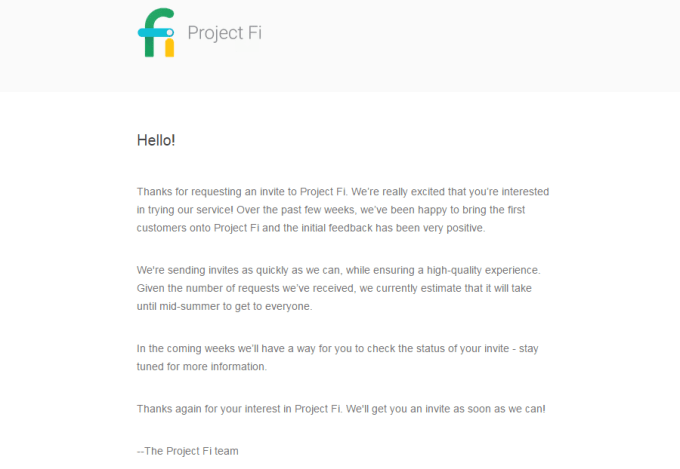
Project Fi, Google’s recently announced plans to offer its own wireless cellular service, appears to have a lot of demand – or at least, that’s what an email sent out to potential customers seems to imply. The email informs those who previously registered their interest in trying out the new service that, due to the number of requests Google has received, it will likely take until mid-summer before invites make their way to everyone.
Given that it’s nearly June, that’s not as far away as it sounds, of course. And that doesn’t mean that no one will receive an invite ahead of this “mid-summer” timeframe – after all, Google’s Project Fi’s website indicates that a small number of invites are distributed each week to those who’ve signed up. In fact, according to the email, several of Project Fi’s first customers have already been given access to the network. So far, Google says the early feedback has been positive.
Instead, the email means that the Project Fi invites will not be distributed in their entirety for several weeks to come.
Google’s email also indicates that potential customers will soon have a way to track their invite’s status. The company says it will soon release a tool that will allow for this in the weeks ahead.
project-fi_email
The service, in case you missed the earlier reports, is a contract-free MVNO that runs on top of Sprint and T-Mobile’s cellular networks. Initially, subscribers must own a Nexus 6 smartphone to access Google’s network. The phone will also use a special Project Fi SIM card, which allows the device to connect to 4G LTE networks in the U.S. and elsewhere in the world. Plans start at $20 per month for unlimited talk and text, plus Wi-Fi tethering (to use the phone as a hotspot). Then you will pay $10 per GB of data used – e.g. $10 for 1 GB, $20 for 2 GB, etc.
What potentially makes the network appealing outside of its contract-free nature and easy-to-understand cost structure is that you’ll receive credit for your unused data at the end of the month. So, for example, if you pay $30 for 3 GB but only use half of that, you’ll receive $15 back.
The service is also tied into Google Hangouts, allowing you to place calls from your phone number on any Hangouts-enabled tablet or laptop in addition to your phone.

NSA planned to hack Google Play, Samsung app store

The US National Security Agency developed plans to hack into data links to app stores operated by Google and Samsung to plant spyware on smartphones, a media report said Thursday. 

Online news site The Intercept said US intelligence developed the plan with allies in Britain, Canada, New Zealand and Australia, a group known as the "Five Eyes" alliance. 

The report, based on a document leaked by former NSA contractor Edward Snowden, said the plan aimed to step up surveillance efforts on smartphones. 

The plan appeared to have been discussed at meetings involving the intelligence services in 2011 and 2012, according to the classified document. 

The project called "Irritant Horn" would allow the agencies to hijack data connections to app stores and surreptitiously implant malicious software on smartphones that would allow for data to be harvested. 

The intelligence agencies could also use the spyware to send misinformation to targets to confuse potential adversaries, according to the report. 

The Intercept said the plan was motivated in part by concerns about the possibility of "another Arab Spring," or the spread of popular movements. 

The agencies were particularly interested in the Africa region, especially Senegal, Sudan and the Congo but also targeted app store servers in France, Cuba, Morocco, Switzerland, Bahamas, the Netherlands and Russia. 

At the time, the Google app store was called Android Market. It is now known as Google Play. 

In developing the plan the agencies found weaknesses in UC Browser, an app owned by Alibaba Group which is popular in China and India to browse the internet and is used by some 500 million people worldwide. 

The document was also published in Canada by CBC News, which said the aim of the plan was to collect data on suspected terrorists and other intelligence targets, including their online search queries, sim card numbers, device IDs and the location of the smartphone. 

In one case, according to the CBC, analysts found a foreign military using the UC Browser app to communicate covertly about its operations in Western countries. 

There was no immediate comment on the report following AFP queries to the NSA or Google. Samsung declined comment. 

The report is the latest based on leaked documents from Snowden describing vast programs by NSA and other services to scoop up data in the search for terrorists. 

The leaks starting in 2013 shocked many Americans and US allies and have led to calls for reform of laws governing US data collection.

Alibaba-owned UC Browser found to leak data

A popular mobile web browser from a company that Alibaba paid more than $1 billion for last year leaks sensitive user data and is a privacy risk, a Canadian technology research group said on Thursday.
Citizen Lab said Chinese and English-language versions of UC Browser, developed by UCWeb Inc, made easily available to third parties personally identifiable information like location, search details and mobile subscriber and device numbers.
The transmission of this information “represents a privacy risk for users because it allows anyone with access to the data traffic to identify users and their devices, and collect their private search data”, it said in a report.
Alibaba spokesman Bob Christie said the problems were immediately fixed and customers notified of an update to the browser after Citizen Lab brought the issues to Alibaba’s attention in April.
“We take security very seriously and we do everything possible to protect our users,” he said.
A UCWeb spokesman declined immediate comment.
Citizen Lab, based at the University of Toronto, said UC Browser had more than 500 million registered users and was the most popular web browser in China and India.
Citizen Lab said the Chinese version was more vulnerable and said that by installing and opening that version users exposed “a significant number” of personal identifiers and location information to third parties.
“By leaking a large volume of fine-grained data points to multiple network operators, the UC Browser app is increasing the risks to its users that such data may be used against them by authorities, criminals, or other third parties,” it said.
Alibaba acquired UCWeb last June, in what was at the time the biggest merger in Chinese internet history.

Thursday, 21 May 2015

Longer-Lasting Batteries Are Almost Here (Really!)

THE MOST IMPORTANT spec on any portable gadget—phone, tablet, laptop, watch—isn’t processor speed or a pixel-packed display. It’s how long you can use it before it becomes a blank brick in need of an outlet. And while the next big battery-life breakthrough may still be a few years away, recent advances are bringing us oh-so-close to giving our gear more of what it needs most of all: time.
Let’s acknowledge that, yes, there’s chatter of a new miracle battery every few years if not months, and nothing ever seems to come of it. That silence doesn’t always equate to failure, though, according to the Joint Center for Energy Storage Research’s Jeff Chamberlain.
“We hear about a new battery announcement every month, or every couple of weeks; the problem is solved, the next generation is here. And then years go by,” Chamberlain tells. And the problem isn’t always the battery itself, but how hard batteries are to manufacture, he says.
Help, however, really is coming. In some ways it’s already here.

Work With What You’ve Got:


The basic lithium ion battery that we use today hasn’t changed dramatically since Sony first started selling them to consumers in 1991. Economies of scale and various tweaks along the way have helped improve efficiency about 10 percent a year, says Chamberlain, but that still makes lithium ion a relative tortoise in a world more accustomed to progress in Moore’s Law-style leaps. It’s no wonder we’re all hungry for a major breakthrough.
That could come one of two ways. The first is what produces all of those flashy headlines that never seem to amount to much: Figure out what what kind of chemistry comes after the tech we’ve been using for decades. That’s the moonshot, the flash fix that will make today’s batteries seem downright Neanderthalic. The more realistic goal though, at least in the near term? Make the most of what you’ve got. And what we’ve got is lithium ion.
It’s an important development both because it doesn’t require lithium ion technology itself to advance to reap benefits, and because it can be applied to devices of any size and shape. The smaller the device—a phone, a watch—the more crucial it becomes to use all available space.The most recent example of creative ways around lithium ion’s limitations came from a perhaps unlikely source: Apple’s new MacBook, announced earlier this month. The entry-level laptop features a unique battery design that uses “terraced” battery cells to stuff every available centimeter of a device with power. It doesn’t make batteries any more efficient or any safer, but it does give Apple the ability to squeeze as much juice into any device as is physically possible.
There are other ample opportunities in the lithium ion space. Because so much money is tied into the industry—annual sales are in the tens of billions—the work going on in most labs is understandably secretive. But Chamberlain points to potential in everything from a better coating process to experimenting with changes in the electrolyte, anode, cathode, and beyond. It’s not impossible to imagine a lithium ion that doubles the performance of what we use today.
And if you look further down the horizon, to the point where we’ve moved past lithium ion altogether? The possibilities are even more impressive.

A Solid Lead:


There are plenty of cutting-edge battery types to choose from. Multivalents promise increased electrical current in the same density, while rechargeable flow batteries have much longer life spans than their lithium ion counterparts. Batteries with gelatinous electrolytes could generate higher voltage. But the next-generation tech that’s caught the most attention recently, thanks to a hefty investment by Dyson, is solid state.
Dyson, famous for its vacuums but producer of a wide array of products that would benefit from a longer-lasting, faster-recharging battery, recently pumped $15 million into a company called Sakti3, one of several labs looking into the potential of solid state electrolyte batteries. As the name suggests, these differ from traditional lithium ion batteries by using solid electrodes and electrolytes instead of liquid. The net result? A battery that can pack in more energy while also presenting less of a safety risk by doing away with the flammable liquid electrolytes used today.

Sakti3, like all private battery researchers, hasn’t provided much detail about its process, but does claim to have already generated twice the energy density of the most advanced lithium ion battery on the market today. The real question is whether they can produce that affordably and at scale; even with the Dyson infusion, the company’s commercialization timeline is still a matter of years, not months.
The applications of solid state batteries are also myriad, according to Chamberlain. A cordless vacuum, sure, but you could also conceivable squeeze one into something as small as a smartphone or as big as a car.
And that’s the catch. It’s likely—in fact, almost inevitable—that Sakti3 will fall into the same pattern that so many battery headline-grabbers have before. Quick burst of hope, just as quickly forgotten.
What that doesn’t mean, though, is that progress has disappeared with it. Work continues on solid state, and on myriad other research into new materials that could give us five times what we’re used to, both by Chamberlain’s team at the Argonne National Laboratory and in privately labs around the world. What battery research is lacking isn’t potential. It’s patience.

Tuesday, 19 May 2015

Intel, CoreOS Aim to Make Your Datacenter as Smart as Google’s

The goal of the joint project is to build a hyperscale-Cloud architecture with automated containers and appliances:
Intel has announced an effort with groundbreaking container developer CoreOS to design appliances that could make any corporate datacenter as smart as Google’s.
The two companies announced a joint project Intel officials described as an effort to democratize the sophisticated management and automation of hyperscale Cloud-computing environments by combining CoreOS containers with Google’s open-source infrastructure-management software Kubernetes, running preconfigured on appliances delivered by Intel OEM partners.
The result should be to make available to ordinary companies the efficiency, flexibility and performance demonstrated by the automated, virtualized “orchestrated container concept” that underpins hyperscale datacenters at Google, Facebook and elsewhere, according to an announcement of the partnership in a recent blog by Jonathan Donaldson, VP and general manager of Intel’s Software Defined Infrastructure group.
“At Intel, we are excited to be a part of the broad ecosystem that is working to bring containers to the masses,” Donaldson wrote in his announcement of the deal. “This is a key component of our desire to see private and hybrid Cloud computing grow significantly over next few years.”
CoreOS is packaging its container technology with a commercial version of Kubernetes – a systems-software management tool developed by Google to make it possible to run clusters of hundreds or thousands of containers from CoreOS rival Dockers as if they were a single system.
Kubernetes is designed to take over task scheduling and management for Docker containers, handle load balancing, provisioning and orchestration, and add self-healing functions to re-start failed processes, reschedule jobs, replicate containers to where they’re needed and group many containers into a single image of the application they represent to make it more easily addressable by users and other systems, according to Google’s Kubernetes documentation on GitHub.
Kubernetes supports CoreOS, but relies on Docker’s management infrastructure to download images into and run the containers that make up the clusters that make up the nodes that make up the services Kubernetes controls.
Support for API functions are spread around among management nodes to put interfaces to applications close to the hardware on which they run, but, so far, the master Controller Manager Server that controls the whole architecture is still centralized and run outside of containers, making the whole structure more hierarchical and dependent on top-down management to be as efficient as it could be, according to the Kubernetes site.
CoreOS bundled its Linux-based application container – which is built on the open-source version of Docker – with Kubernetes to get Tectonic — which packages all the components for a  Google-like Kubernetes-controlled Cloud infrastructure, but adds dashboards, workflow tools, registries to connect shared Linux containers and other refinements designed to fit more neatly into existing corporate datacenters.
In that effort CoreOS, which refers to Tectonic as “Google’s infrastructure for everyone else,” launched Tectonic April 6 with the help of a $12 million investment from Google Ventures, which expects to see enterprise computing mirror the techniques and structures of hyperscale cloud providers, according to a  statement in the announcement from Google Ventures partner Dave Munichiello.
Google’s goal for Kubernetes is to have it run on all Cloud platforms, not just Google’s, according to Google’s Kubernetes product lead Craig McLuckie in the same announcement.
“Our Google Cloud Platform customers benefit from modern management patterns pioneered in Google, and Tectonic frees them to pick their Cloud provider solely on the merits of their infrastructure, with no lock-in whatsoever,” he said.
Intel’s goal is to help CoreOS scale tectonics quickly and package it conveniently enough to be rolled out easily and efficiently to traditional datacenters, Donaldson wrote in his blog.
One good way to do that is to help OEMs build the whole package into highly modular datacenter server hardware customers can use to easily build datacenter-based Cloud servers that work like Google’s but are far easier to manage.
“We expect that this work will lead to ready-to-ship, hyperscale Cloud systems that coincide with the future GA release of the Tectonic suite,” Donaldson wrote.
Intel has not delivered a full set of reference specifications for the Tectonics bundle running on Intel hardware, or announced pricing for servers running it. It has announced that two companies – modular-server maker Supermicroand integrator Redapt – would sell Intel-powered versions of Tectonic servers.
The Tectonic prototypes have already gotten a 2X boost in performance using asynchronous DRAM self-refresh – a feature Intel added to Xeon E5-2400 v2 chips in 2014 – according to a May 5 post from CoreOS CEOAlex Polvi that described the effort.
“This is the beginning of a deep partnership to enable businesses to take advantage of containers, distributed systems, and the next generation of infrastructure,” Polvi wrote.